Acerodon jubatusgolden-capped fruit bat

Geographic Range
Acerodon jubatus is endemic to the Philippines, with the exceptions of the Palawan region and the Batanes and Babuyan island groups. (Mildenstein, et al., 2008; Wilson and Reeder, 2005)
- Other Geographic Terms
- island endemic
Habitat
Acerodon jubatus roosts in hardwood trees, often on cliff edges or steep, inaccessible slopes. Other preferred roosting sites include bamboo clumps, mangrove trees, and other swampy forested areas. Roosting sites are usually located on small, offshore islands. Acerodon jubatus has been observed to use disturbed areas for roosting. (Mildenstein, et al., 2008; Mudar and Allen, 1986; Nowak, 1991)
When foraging, Acerodon jubatus exhibits a strong preference for primary forest or high-quality secondary forest over disturbed habitat, and may fly long distances (up to 16 km) from its roost to reach these locations. There is also a preference for river margins, probably due to their particular plant communities. Acerodon jubatus is rarely found foraging in disturbed or agricultural areas, though it regularly crosses such areas while traveling between forested regions. (Mildenstein, et al., 2005; Mildenstein, et al., 2008; Nowak, 1991; Stier and Mildenstein, 2005)
- Habitat Regions
- tropical
- terrestrial
- Terrestrial Biomes
- forest
- Wetlands
- swamp
- Other Habitat Features
- riparian
-
- Range elevation
- 0 to 1100 m
- 0.00 to 3608.92 ft
Physical Description
Like other bats in the Family Pteropodidae, Acerodon jubatus has large, bright eyes and relatively simple external ears with continuous margins. The ears are about as long as the muzzle and are pointed. There is a claw on the second digit of each wing. The skull has strong, incomplete postorbital processes, with supraorbital foramena. The teeth are sharp and pointed, except for the last two molars. (Ingle and Heaney, 1992; Taylor, 1934)
The fur of Acerodon jubatus is thin on the throat and ear membranes, absent on the wing membranes, and short and smooth on the body. There is considerable variation in color but the typical scheme is dark brown or black on the forehead and sides of the head, reddish brown on the shoulders, and a dark brown or black on the lower back and underside. The nape ranges from cream to golden yellow. There is a narrow line of orange at the back of the neck. Variable numbers of yellow hairs are scattered throughout the fur, especially on the lower body. Variation in color does not depend on age, sex, or locality. (Nowak, 1991; Taylor, 1934)
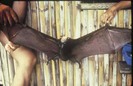
The head and body length combined ranges from 178 to 290 mm; there is no tail. The forearm varies between 125 and 203 mm, and the wingspan varies between 1.51 and 1.7 m. Weights between 1050 and 1200 g have been reported, making Acerodon jubatus among the largest bats in the world. Males are larger and heavier than females. (Heaney and Heideman, 1987; Ingle and Heaney, 1992; Mudar and Allen, 1986; Nowak, 1991)
- Other Physical Features
- endothermic
- homoiothermic
- bilateral symmetry
- Sexual Dimorphism
- male larger
-
- Range mass
- 1050 to 1200 g
- 37.00 to 42.29 oz
-
- Range length
- 178 to 290 mm
- 7.01 to 11.42 in
-
- Range wingspan
- 1.51 to 1.7 m
- 4.95 to 5.58 ft
Reproduction
No information is currently available on the mating system of Acerodon jubatus.
Acerodon jubatus populations on all islands reproduce at approximately the same time, indicating that they probably use photoperiod as a cue instead of more localized environmental conditions. Females give birth during April and May, and possibly early June. Females in captivity give birth only once every two years; those in the wild likely reproduce less often. Not much about litter size is known, but females have not been observed with more than one offspring at a time. (Heideman, 1987; Mildenstein, et al., 2008)
- Key Reproductive Features
- iteroparous
- seasonal breeding
- gonochoric/gonochoristic/dioecious (sexes separate)
- sexual
- viviparous
-
- Breeding interval
- Females can breed as often as once every two years.
-
- Breeding season
- Births occur from April to June, but gestation periods are unknown, so the breeding season has yet to be determined
-
- Average number of offspring
- 1
Females have been observed to carry a single offspring. The young cling to their mothers' fur with their claws, while the mothers fan them with one wing to keep them cool. Females invest significantly in their young through gestation and lactation. (Taylor, 1934)
- Parental Investment
- altricial
-
pre-fertilization
- provisioning
-
protecting
- female
-
pre-hatching/birth
-
provisioning
- female
-
protecting
- female
-
provisioning
-
pre-weaning/fledging
-
provisioning
- female
-
protecting
- female
-
provisioning
Lifespan/Longevity
No information is currently available on longevity in Acerodon jubatus.
Behavior
Acerodon jubatus individuals roost with other bat species, especially Pteropus vampyrus and occasionally Pteropus hypomelanus. They are typically outnumbered by these other species, making up less than 20% of the total roost population. Mixed colonies of 100,000 to 150,000 individuals were reported in the early 1900s to 1920s; recently, however, no colonies over 30,000 individuals have been observed, and many are no larger than 5,000 individuals. Bats emerge from the colony at sunset, fly into the mountains to feed on fruit, and return before sunrise. (Heaney and Heideman, 1987; Mildenstein, et al., 2008; Taylor, 1934)
Home Range
Home range sizes for golden-capped fruit bats are not known.
Communication and Perception
Acerodon jubatus individuals have large eyes and may use visual cues in communication. They have a distinctive odor, suggesting olfactory communication, but no specific scent glands have been identified.
Food Habits
Golden-capped fruit bats are frugivores. Figs (Ficus) appear to be a dietary staple, as fig seeds compose 41% of droppings on average. Ficus subcordata is the most commonly eaten species, though Acerodon jubatus also shows a strong preference for fruits from other Ficus species and, to a lesser extent, Ficus variegata. Not every fig species is used, and the dietary range is narrower than other bats in the same area. Notably, these staple plants are only found in mature lowland forests, making golden-capped fruit bats forest obligates. They also consume leaves by crushing them and swallowing the liquid content, but how much of the diet is composed of leaves is unknown. (Stier and Mildenstein, 2005)
- Plant Foods
- leaves
- fruit
Predation
There are no known predators of Acerodon jubatus.
Ecosystem Roles
Golden-capped fruit bats, as frugivores, are distributors of plant seeds. The impact of such distribution on the local ecosystem has not been recorded. (Stier and Mildenstein, 2005)
- Ecosystem Impact
- disperses seeds
Economic Importance for Humans: Positive
Some large bat roosts, shared by Acerodon jubatus and other species, are used as tourist attractions. (Mildenstein, et al., 2008)
Golden-capped fruit bats are hunted for consumption. They are also occasionally captured live for exportation, though this is uncommon because they are said to have an unpleasant smell compared to other, similar bats. These practices have contributed to the species's endangered status. (Mildenstein, et al., 2008)
- Positive Impacts
- pet trade
- food
- ecotourism
Economic Importance for Humans: Negative
There are no known adverse effects of Acerodon jubatus on humans.
Conservation Status
Golden-capped fruit bats are listed as endangered by the IUCN and appear in Appendix I of CITES. Populations are experiencing severe declines due to habitat loss from logging and farming projects and hunting for meat or trade. They are particularly susceptible to habitat loss because of their dependence on fig trees found only in mature old-growth forest. This species is protected, with three large roost sites entirely exempt from hunting, but the bats are still hunted while foraging away from the roosts. The population is estimated at about 10,000 individuals; this represents a 50% decline over the last 30 years. The decline is predicted to continue unless destruction of old-growth forest ceases. Populations now recognized as A. jubatus (Acerodon lucifer) are now extinct. ("Appendices I, II, and III", 2008; Heaney and Heideman, 1987; Mildenstein, et al., 2008)
-
- IUCN Red List
-
Endangered
More information
-
- IUCN Red List
-
Endangered
More information
-
- US Federal List
- No special status
-
- CITES
- Appendix I
Other Comments
This species now includes Panay golden-crowned flying foxes, Acerodon lucifer, which was once considered a separate species. There appear to be no morphological differences to distinguish the two taxa. It is not known whether they are behaviorally identical, and this will probably never be determined because the Panay population appears to be extinct. (Ingle and Heaney, 1992; Mildenstein, et al., 2008)
Contributors
Virginia Heinen (author), Michigan State University, Barbara Lundrigan (editor, instructor), Michigan State University, Tanya Dewey (editor), Animal Diversity Web.
Glossary
- acoustic
-
uses sound to communicate
- altricial
-
young are born in a relatively underdeveloped state; they are unable to feed or care for themselves or locomote independently for a period of time after birth/hatching. In birds, naked and helpless after hatching.
- bilateral symmetry
-
having body symmetry such that the animal can be divided in one plane into two mirror-image halves. Animals with bilateral symmetry have dorsal and ventral sides, as well as anterior and posterior ends. Synapomorphy of the Bilateria.
- chemical
-
uses smells or other chemicals to communicate
- colonial
-
used loosely to describe any group of organisms living together or in close proximity to each other - for example nesting shorebirds that live in large colonies. More specifically refers to a group of organisms in which members act as specialized subunits (a continuous, modular society) - as in clonal organisms.
- ecotourism
-
humans benefit economically by promoting tourism that focuses on the appreciation of natural areas or animals. Ecotourism implies that there are existing programs that profit from the appreciation of natural areas or animals.
- endothermic
-
animals that use metabolically generated heat to regulate body temperature independently of ambient temperature. Endothermy is a synapomorphy of the Mammalia, although it may have arisen in a (now extinct) synapsid ancestor; the fossil record does not distinguish these possibilities. Convergent in birds.
- food
-
A substance that provides both nutrients and energy to a living thing.
- forest
-
forest biomes are dominated by trees, otherwise forest biomes can vary widely in amount of precipitation and seasonality.
- frugivore
-
an animal that mainly eats fruit
- herbivore
-
An animal that eats mainly plants or parts of plants.
- island endemic
-
animals that live only on an island or set of islands.
- iteroparous
-
offspring are produced in more than one group (litters, clutches, etc.) and across multiple seasons (or other periods hospitable to reproduction). Iteroparous animals must, by definition, survive over multiple seasons (or periodic condition changes).
- motile
-
having the capacity to move from one place to another.
- native range
-
the area in which the animal is naturally found, the region in which it is endemic.
- nocturnal
-
active during the night
- oriental
-
found in the oriental region of the world. In other words, India and southeast Asia.

- pet trade
-
the business of buying and selling animals for people to keep in their homes as pets.
- riparian
-
Referring to something living or located adjacent to a waterbody (usually, but not always, a river or stream).
- seasonal breeding
-
breeding is confined to a particular season
- sedentary
-
remains in the same area
- sexual
-
reproduction that includes combining the genetic contribution of two individuals, a male and a female
- social
-
associates with others of its species; forms social groups.
- swamp
-
a wetland area that may be permanently or intermittently covered in water, often dominated by woody vegetation.
- tactile
-
uses touch to communicate
- terrestrial
-
Living on the ground.
- tropical
-
the region of the earth that surrounds the equator, from 23.5 degrees north to 23.5 degrees south.
- visual
-
uses sight to communicate
- viviparous
-
reproduction in which fertilization and development take place within the female body and the developing embryo derives nourishment from the female.
References
2008. "Appendices I, II, and III" (On-line). Convention on International Trade in Endangered Species of Wild Fauna and Flora. Accessed March 05, 2009 at http://www.cites.org/eng/app/appendices.shtml.
Heaney, L., P. Heideman. 1987. Philippine Fruit Bats: Endangered and Extinct. BATS Magazine, 5(1): 3-5. Accessed March 05, 2009 at http://www.batcon.org/index.php/education/article-and-information/bats-magazine.html?task=viewArticle&magArticleID=276.
Heideman, P. 1987. The Reproductive Ecology of a Community of Philippine Fruit Bats (Pteropodidae, Megachiroptera). Ann Arbor, MI: University Microfilms International. Accessed March 09, 2009 at http://p2047-ezproxy.msu.edu.proxy2.cl.msu.edu/login?url=http://proquest.umi.com.proxy2.cl.msu.edu/pqdweb?did=753014291&sid=1&Fmt=2&clientId=3552&RQT=309&VName=PQD.
Ingle, N., L. Heaney. 1992. A key to the bats of the Philippine Islands. Chicago, IL: Field Museum of Natural History. Accessed March 06, 2009 at http://www.archive.org/details/keytobatsofphili69ingl.
Mildenstein, T., A. Cariño, S. Paul, L. Heaney, P. Alviola, A. Duya, S. Stier, S. Pedregosa, R. Lorica, N. Ingle, D. Balete, J. Garcia, J. Gonzalez, P. Ong, G. Rosell-Ambal, B. Tabaranza. 2008. "IUCN 2008 Red List: Acerodon jubatus" (On-line). 2008 IUCN Red List of Threatened Species. Accessed March 05, 2009 at http://www.iucnredlist.org/details/139.
Mildenstein, T., S. Steir, C. Nuevo-Diego, L. Mills. 2005. Habitat selection of endangered and endemic large flying-foxes in Subic Bay, Philippines. Biological Conservation, 126(1): 93-102.
Mudar, K., M. Allen. 1986. A list of bats from northeastern Luzon, Philippines. Mammalia, 50(2): 219-225.
Nowak, R. 1991. Walker's Bats of the World. Baltimore & London: Johns Hopkins University Press.
Stier, S., T. Mildenstein. 2005. Dietary Habits of the World's Largest Bats: The Phillipine Flying Foxes, Acerodon Jubatus and Pteropus Vampyrus Lanensis. Journal of Mammology, 86(4): 719-729.
Taylor, E. 1934. Philippine Land Mammals. Manila, Philippine Islands: Monographs of the Bureau of Science.
Wilson, D., D. Reeder. 2005. Mammal Species of the World. A Taxanomic and Geographic Reference (3rd ed). Baltimore: Johns Hopkins University Press.