Abrocoma cinereaashy chinchilla rat
Geographic Range
Chinchilla rats, Ambrocoma cinerea are restricted to the Altiplano of the Andes of South America, from Southern Bolivia and Peru into Central Chile. (Myers, 1999)
- Biogeographic Regions
- neotropical
Habitat
Chinchilla rats are restricted to the Altiplano region of the Andes, they occur in rocky areas between 3700 and 5000 meters. Burrows can commonly be found under rocks or at the bases of shrubs. (Encarta, 2000; Nowak, 1991).
- Terrestrial Biomes
- mountains
Physical Description
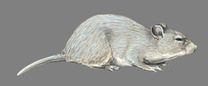
Chinchilla rats range from 15 to 25 cm long, not including the tail, which can be from 6 to 18 cm long. They weigh 200 to 300 g. Chinchilla rats have large, round ears and large eyes, the head is elongate. Limbs are short with 4 digits on the forefoot and 5 on the hindfoot. The fur is thick and soft,silver-gray in color above and white or yellow underneath. The fur is similar in texture to a chinchilla's, though less desirable in the fur trade. (Encarta, 2000; Nowak, 1991)
- Other Physical Features
- endothermic
- bilateral symmetry
-
- Range mass
- 0.200 to 0.300 kg
- 0.44 to 0.66 lb
Reproduction
Very little is known about reproduction in Abrocoma cinerea. The length of gestation ranges from 115 to 118 days with 1-2 young per litter. (Grzimeck, 1975; Nowak, 1991)
- Key Reproductive Features
- iteroparous
- seasonal breeding
- gonochoric/gonochoristic/dioecious (sexes separate)
- sexual
- fertilization
- viviparous
-
- Range number of offspring
- 1 to 3
-
- Average number of offspring
- 2.2
-
- Average gestation period
- 102 days
- Parental Investment
- precocial
Behavior
Chinchilla rats live in small colonies of about six. Burrows may be only 18 meters apart. They communicate using a variety of sounds including grunts, squeaks, and gurgles (Encarta, 2000; Nowak, 1991).
Communication and Perception
Food Habits
Chinchilla rats are herbivorous and nocturnal. The diet includes seeds, fruits, and nuts. Though primarily terrestrial, they are capable of climbing as well. (Encarta, 2000; Encyclopedia Britannica Online, 2000)
Economic Importance for Humans: Positive
There is no great economic importance to humans. Skins of chinchilla rats are sometimes sold at fur markets but are not of much value (Nowak, 1991).
Conservation Status
Chinchilla rats are somtimes hunted for pelts. There is no true commercial value but they are sometimes sold to travelers as true Chinchilla. For this reason, and because of habitat destruction, they have become rare. (Nowak, 1991).
-
- IUCN Red List
-
Least Concern
More information
-
- IUCN Red List
-
Least Concern
More information
-
- US Federal List
- No special status
-
- CITES
- No special status
Contributors
Natalee Nash (author), Fresno City College, Carl Johansson (editor), Fresno City College.
Glossary
- Neotropical
-
living in the southern part of the New World. In other words, Central and South America.

- bilateral symmetry
-
having body symmetry such that the animal can be divided in one plane into two mirror-image halves. Animals with bilateral symmetry have dorsal and ventral sides, as well as anterior and posterior ends. Synapomorphy of the Bilateria.
- chemical
-
uses smells or other chemicals to communicate
- endothermic
-
animals that use metabolically generated heat to regulate body temperature independently of ambient temperature. Endothermy is a synapomorphy of the Mammalia, although it may have arisen in a (now extinct) synapsid ancestor; the fossil record does not distinguish these possibilities. Convergent in birds.
- fertilization
-
union of egg and spermatozoan
- granivore
-
an animal that mainly eats seeds
- herbivore
-
An animal that eats mainly plants or parts of plants.
- internal fertilization
-
fertilization takes place within the female's body
- iteroparous
-
offspring are produced in more than one group (litters, clutches, etc.) and across multiple seasons (or other periods hospitable to reproduction). Iteroparous animals must, by definition, survive over multiple seasons (or periodic condition changes).
- motile
-
having the capacity to move from one place to another.
- mountains
-
This terrestrial biome includes summits of high mountains, either without vegetation or covered by low, tundra-like vegetation.
- native range
-
the area in which the animal is naturally found, the region in which it is endemic.
- seasonal breeding
-
breeding is confined to a particular season
- sexual
-
reproduction that includes combining the genetic contribution of two individuals, a male and a female
- social
-
associates with others of its species; forms social groups.
- tactile
-
uses touch to communicate
- viviparous
-
reproduction in which fertilization and development take place within the female body and the developing embryo derives nourishment from the female.
- young precocial
-
young are relatively well-developed when born
References
2000. "Chinchilla Rat" (On-line). Accessed Sept 24 at http://www.britannica.com/seo/c/chinchilla-rat/.
2000. Chinchilla Rat. Microsoft Encarta Encyclopedia 2000.
Grzimeck, B. 1975. The Cavies: The Family of Rat Chinchillas. Pp. 422, 427 in Grzimeck's Animal Life Encyclopedia Vol. 2 Mammals 2. New York: Van Nostrand Co..
Myers, P. Nov. 27, 1999. "Ambrocomidae" (On-line). Accessed Oct.14, 2000 at http://animaldiversity.ummz.umich.edu/chordata/mammalia/rodentia/abrocomidae.html.
Nowak, R. 1991. Rodentia: Ambrocomidae Chinchilla Rats or Chinchillones. Pp. 941-942 in Walker's Mammals of the World 5 Ed. Vol.2. Baltimore and London: Johns Hopkins University Press.