Salmo trutta


Geographic Range
The historic native geographic range of the brown trout, Salmo trutta, is Europe, northern Africa, and western Asia. The northern range boundary includes Iceland, Scandanavia and Russia. The Pacific ocean marks the western boundary. The southern boundary is the coastline on the Mediterranean Sea including the islands of Corsica, Sardinia, and Sicily. Also marking a southern border is Atlas Mountain located in Northern Africa. Western range borders are the Ural Mountain range, considered to be the border between Europe and Asia. Today, the brown trout has been successfully introduced into waterways on every continent with the exception of Antarctica. The first brown trout in the western hemisphere arrived in New York in 1883, and are now found throughout most of the United States. ("Brown trout management plan", 2001; Klemetsen, et al., 2003; MacCrimmon and Marshall, 1968)
- Biogeographic Regions
- nearctic
- palearctic
- oriental
- ethiopian
- neotropical
- australian
- oceanic islands
- indian ocean
- atlantic ocean
- pacific ocean
- mediterranean sea
- Other Geographic Terms
- holarctic
- cosmopolitan
Habitat
The preferred habitat for brown trout is deep streams with moderate to low water currents, although they can be found in lakes. The depth at which they swim is dependent upon the size and stage of life. Parr, juvenile brown trout feeding away from the nest, are normally found in the shallow waters less than 30 cm, while adults are deeper in the stream. Brown trout select what water currents they inhabit depending on their size. Parr normally stay in moderately slower, 20 to 50 cm/s, riffles in the backwaters of streams or along the banks. Larger adult brown trout occupy the slow moving water closer to the center of waterways, away from the banks. Brown trout also make use of eddies, slow moving pools of water, in the river. The preferred substrate is rocky bottoms that provide cover, but also gravel sand, silt, and mud. Depending on accessibility, some brown trout are anadromous. Anadromous trout will spend most of their adult life in the ocean, only returning to freshwater to spawn. Newly hatched brown trout alevins and fry will experience a gradual habitat shift from their gravel redd to the more open riverbed to feed. Some brown trout may not migrate and choose to stay within their natal stream throughout their life. (Cunjak and Power, 1986; Heggenes, 1996; Klemetsen, et al., 2003; Shirvell and Dungey, 1983; Stauffer, Jr., et al., 1995)
- Habitat Regions
- temperate
- saltwater or marine
- freshwater
- Aquatic Biomes
- pelagic
- lakes and ponds
- rivers and streams
- brackish water
-
- Range depth
- 0.03 to 1.22 m
- 0.10 to 4.00 ft
-
- Average depth
- 0.65 m
- 2.13 ft
Physical Description
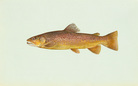
Adult brown trout are between 18 to 56 cm long, and can weigh from 9 to 24 kg. The brown trout has two pectoral fins having 12 to 15 rays, two pelvic fins with 9 to 10 rays, an anal fin with 10 to 13 rays, a dorsal fin having 14 to 16 rays, an adipose fin, and a caudal fin. The caudal fin, lacking spines, can appear in various shapes including broad, forked, emarginated, or truncate. Brown trout have a large terminal mouth with the jaw extending to, or just past, the back edge of the eyes. Breeding males will develop a hook-like, upward-facing protrusion on the lower jaw called a kype. In a natural setting the top of the trout is an olive color with brown and black spots with the ventral side being tan to yellow. The sides of the fish have many orange and red spots ringed with a light blue. Juvenile trout have less spots than the adults with the exception of having "parr marks", which are large dark ovals that run down the sides of the fish. These markings disappear as they age. Male brown trout have a larger head than the females, while the females display a larger abdomen. (Jenkins and Burkhead, 1993; Klemetsen, et al., 2003; Trautman, 1981)
- Other Physical Features
- ectothermic
- bilateral symmetry
- Sexual Dimorphism
- sexes shaped differently
-
- Range mass
- 0.5 to 24 kg
- 1.10 to 52.86 lb
-
- Range length
- 18 to 56 cm
- 7.09 to 22.05 in
Development
Salmo trutta eggs are buried in a gravely nest called a redd, incubate for 1 to several months, and are ready to hatch the following spring. Once the eggs hatch an alevin emerges, which is the first life stage of the brown trout. It has a yolk sac attached to its belly to be used as a temporary food source. Alevins stay within the gravel nest but once the yolk sac is nearly consumed the alevins emerge from the gravel redd as fry. Fry tend to stay near the general area of the redd as they compete for food. As the fry grow, they venture out to other areas of the riverbed and are now known as parr. Parr are juvenile brown trout that are actively feeding and establishing territories away from their nesting sites. Parr also have the distinguishable characteristic of dark vertical ovals, known as parr marks, that run down the sides of the fish.
If Salmo trutta has access to the sea, it will undergo smoltification, which is taking on a silvery color while migrating to the ocean to reach maturity. The silvery color is acquired while brown trout transition from freshwater to saltwater, if anadromous. Adulthood may be reached in either saltwater or freshwater. Anadromous trout will reach maturity at sea while freshwater stream residents will achieve sexual maturity between 1 to 10 years.
Rate of growth is dependent on environmental factors such as temperature, food availability, and population density. Egg incubation temperature and size of the mother also determines the size of the newly hatched trout. As incubation temperature increases, the alevin size decreases. The best temperature for the growth of brown trout is 13 to 18 degrees Celsius. As the brown trout grows it needs to exploit larger food particles in greater quantity; if food is scarce then growth rate is slowed down. In addition, if there is a large population of brown trout or other species competing for the same food source then this also limits growth. (Jenkins and Burkhead, 1993; Klemetsen, et al., 2003)
- Development - Life Cycle
- indeterminate growth
Reproduction
Both females and males have a choice in selection of their mate. Males will court a female by various methods. Two males will slowly swim side by side and quiver in an effort to drive the other away. Males will charge each another with an open mouth and not come in contact, or they may come into contact with an opponent in an act called ramming. Males will also bite their competition. Once courting is complete males will perform an act called "chasing" in order to drive the defeated male away and prevent him from returning. Males perform these acts multiple times with other males, resulting in a social hierarchy of dominant males. Trout with established territories will also defend their space by chasing other trout away year-round.
It is likely that female brown trout will select a male based on the size of his adipose fin. The larger the fin, the larger the chance the male will be selected. In addition to female choice, a case study has been done that shows intrasexual competition between males will overrule the choice of the female in nearly all situations. In the study, 14 females were individually introduced to 2 males with different adipose fin size. The males were in separate cages and had no form of interaction with each other. Seventy-four percent of the time the female chose to prepare her nesting site, called a redd, closest to the male with the larger adipose fin, and even showed aggression to the male with the smaller fin. This result clearly showed that females show some selection in the mating process. Once the nest was complete, the males were released from their enclosures. The males begin to court the female and fight with each other. Fifty-seven percent of the time the female's choice was overridden as a result of male-male competition. (Petersson, et al., 1999)
- Mating System
- polygynandrous (promiscuous)
All brown trout will return to their natal stream in order to mate. The time in which brown trout achieve sexual maturity varies. Some freshwater resident brown trout achieve sexual maturity anywhere from 1 to 10 years. Anadromous trout will achieve their sexual maturity while at sea and will return the following season to spawn, or may stay at sea for 2 to 3 years before returning to reproduce. Age at sexual maturation is dependent on genotypic differences. Genotypic differences are also responsible for the sexual maturation age difference between anadromous and freshwater resident trout.
The seasons in which Salmo trutta will mate range from autumn to winter. The females may be reproductively active over a few days and will often choose other appropriate nesting grounds in another location of the stream or river to spawn a second time. Females choose a gravel or stony bottom as a nesting site and will dig their nests, called redds, in the foundation of the riverbed. Larger females will choose a substrate with much coarser gravel or stones and will also dig their nest deeper. The female will lay between 300 to 1500 eggs in a series of nests she previously created. Fertilization is external, so once she has laid her eggs in the nest, the male fertilizes them. After fertilization, the female will begin to bury the eggs with stones or gravel. Once the female is reproductively inactive for the season, she will leave and provide no parental care. (Jonsson, 1989; Klemetsen, et al., 2003)
- Key Reproductive Features
- seasonal breeding
- gonochoric/gonochoristic/dioecious (sexes separate)
- sexual
- fertilization
- oviparous
-
- Breeding interval
- Salmo trutta will be reproductively active over the course of several days during one season of the year.
-
- Breeding season
- Brown trout spawn during the seasons of autumn and winter.
-
- Range number of offspring
- 300 to 1500
-
- Average number of offspring
- 8000
- AnAge
-
- Range time to hatching
- 1 to 6 months
-
- Range age at sexual or reproductive maturity (female)
- 1 to 10 years
-
- Range age at sexual or reproductive maturity (male)
- 1 to 10 years
Once the female brown trout has spawned and the male has fertilized the eggs, the female will protect her recently laid eggs by covering them with stones. She also provides provisioning in the eggs. Once the eggs are buried the female abandons the area providing no more parental care. Males will stay in the area to fertilize more eggs, but will also not directly provide any care for the eggs. Eggs are secondarily guarded if a male is defending his personal territory and the eggs happen to be in his territory. (Klemetsen, et al., 2003)
- Parental Investment
-
pre-hatching/birth
-
provisioning
- female
-
protecting
- female
-
provisioning
Lifespan/Longevity
The maximum reported age for the brown trout is 38 years old. Brown trout have been caught in the wild as old as 20 years old, although they normally die at a much younger age. In anadromous populations, brown trout will rarely live past 10 years of age. For anadromous brown trout, latitude plays a key role in longevity. Water temperature increases closer to the equator and results in a decrease in longevity for brown trout populations. For example, brown trout live an average of 8 years in northern Norway and just 3 to 5 years in Britain.
In addition to water temperature, growth rates also play a vital role in lifespan. Growth rate and large body size are factors that correlate with living longer. A fast growing brown trout may expire at an early age because of susceptibility to diseases and metabolic cost it takes to quickly reach sexual maturity. Fast growers are also more vulnerable to predation because they are more active. Slow and steady growth rates are correlated with a longer lifespan. As size increases, metabolism will decrease leading to increased longevity. (Jonsson, et al., 1991; Klemetsen, et al., 2003)
-
- Range lifespan
Status: wild - 38 (high) years
- Range lifespan
-
- Typical lifespan
Status: wild - 3 to 20 years
- Typical lifespan
-
- Average lifespan
Status: captivity - 10.0 years
- Max Planck Institute for Demographic Research
- Average lifespan
Behavior
Brown trout are a mobile organism. In preparation for spawning Salmo trutta will migrate back to its birth stream to spawn. In addition to migrating to different geographic locations, newly hatched alevins and fry will experience a gradual habitat shift from their gravel redd to the more open riverbed to feed. In many cases brown trout will migrate from their home stream to lakes or the ocean depending on accessibility. However, some brown trout, called residents, will not migrate and will permanently stay in their home stream.
Salmo trutta is a social organism when it comes to territory defense and spawning. During spawning season social hierarchies are formed when males fight each other for the right to spawn with a female. Social hierarchies are also established when mating does not occur. Males have a personal territory that they will defend year round. Male fighting techniques include quivering, charging, ramming, biting, and chasing. Males quiver parallel to one another in an attempt to drive away their competition. Charging involves opening the mouth and swimming very quickly at another male to intimidate and drive competition off. Ramming is much like charging, but involves physical contact with each other. A male will bite at another male's fins in order to show his dominance. Once a male submits, the dominant male will chase the subordinate male for a few seconds to truly confirm that he is the winner. (Klemetsen, et al., 2003)
- Key Behaviors
- natatorial
- diurnal
- crepuscular
- motile
- migratory
- sedentary
- territorial
- dominance hierarchies
Home Range
Brown trout do have their own territories and will defend them as young fry. Once the alevins emerge from the gravel redd to the open riverbed as fry, they will defend their territory and social hierarchies will be created. There are no set territorial limits for Salmo trutta as the size is dependent on how much each individual is able to defend. There is however a correlation between body size and territory size. The larger the trout is in length and mass the larger it's personal territory will be. Territory size is also based upon hierarchical dominance. (Elliott, 1990; Petersson, et al., 1999)
Communication and Perception
Brown trout use pheromones during spawning periods. Once the females have ovulated, sex pheromones are released. Once the pheromones are perceived by the males, they exhibit an increase in sexual behavior such as relocating further upstream as well as increased aggression and play fighting with other males. Brown trout also experience an increase in milt, the trout seminal fluid, when pheromones signals are received. Additionally, Atlantic salmon Salmo salar showed an increase in sexual hormones in the presence of brown trout pheromones. This may explain why hybridization may occur. In addition to chemical communication, male trout have a morphological signal. Male brown trout develop an upward hook at the end of their bottom jaw, called a kype. This announces to females and other males that he is ready to breed.
There are two hypotheses regarding chemical communication and navigation. The first hypothesis, called the olfactory hypothesis, states trout and salmon that migrate are imprinted by the chemical make-up of their home waterway. The pheromone hypothesis suggests that trout and salmon are able to pick up on pheromone trails given off by their younger counter-parts already in their home stream.
Like other fish, brown trout utilize their lateral lines to sense changes in their environment such as current changes, vibrations, and pressure differences. This enables the fish to find food more efficiently, as well as indicate when a predator may be near. (Brönmark and Hansson, 2000; Jenkins and Burkhead, 1993; Johnsson, et al., 2001; Montgomery, et al., 1997; Trautman, 1981)
- Communication Channels
- chemical
- Other Communication Modes
- pheromones
- vibrations
- Perception Channels
- visual
- tactile
- vibrations
- chemical
Food Habits
Brown trout are visual opportunistic feeders and also have specialized feeding habits. Salmo trutta is carnivorous, primarily feeding on invertebrates, as well as crustaceans. As Salmo trutta gets older and increase in size, they become increasingly piscivorous, eating fish such as small suckers, minnows, sculpin, and darters. Brown trout that live in lakes and reservoirs normally eat zooplankton on the lake bed, detritus, and in some cases have a diet that only consists of algae. Piscivorous brown trout in rivers and streams will commonly eat trout eggs during the fall and early winter as well as eating terrestrial insects. Anadromous brown trout diet is similar to freshwater brown trout with the inclusion of polychaetes. As anadromous trout migrate to the sea, diet change is gradual from freshwater to marine.
Dominant fish feed mainly at the most beneficial times of the day such as dusk and the early part of the night, whereas more subordinate individuals feed at other times. Insects are more active at dusk making it the optimal feeding time. In addition to time of day, dominant fish will also feed in the optimal place for feeding and may specialize in eating in slow-moving riffles near the surface or fast-moving water near the middle of the water column. Smaller and younger trout will often feed at the surface or shoreline while larger trout will move about the river. ("Brown Trout (Salmo trutta): A Technical Conservation Assessment", 2007; "Brown trout (Salmo trutta) Species and Conservation Assessment", 2008; Klemetsen, et al., 2003)
- Primary Diet
- carnivore
- Animal Foods
- fish
- eggs
- insects
- terrestrial non-insect arthropods
- aquatic or marine worms
- aquatic crustaceans
- zooplankton
- Plant Foods
- algae
- Other Foods
- detritus
Predation
Brown trout are preyed upon by piscivorous birds, mammals and other fish. Common mammalian predators are humans, river otters (Lutra sp.), and mink (Neovison sp. or Mustela). Common avian predators include mergansers (Lophodytes sp.), the great blue heron (Ardea herodias), pelicans (Pelecanus sp.), and kingfishers (Alcedines). Brown trout eggs in redds are open to predation by a wide range of macroinvertebrates. While out in the ocean, anadromous brown trout are susceptible to predation by mammals such as seals and piscivorous fish like cod (Gadus sp.).
To avoid predation, Salmo trutta will stay near overhanging trees or large rocks that provide cover. In addition to using their exceptional vision to find their prey, trout will also search for predators and hide accordingly. ("Brown Trout (Salmo trutta): A Technical Conservation Assessment", 2007)
-
- Known Predators
-
- humans, Homo sapiens
- otters, Lutra sp.
- mink, Neovison sp.
- mink, Mustela sp.
- mergansers, Lophodytes sp.
- Great Blue Heron, Ardea herodias
- pelicans, Pelecanus sp.
- kingfishers, Alcedines sp.
- seals, Pinnipedia sp.
- cod, Gadus sp.
Ecosystem Roles
As introduced species in much of the world, brown trout are driving other species of fish out of the ecosystem by altering the ecosystem's productivity and ability to cycle nutrients. The decline of native populations of salmonids, invertebrates and amphibians can be attributed to the brown trout. Research in New Zealand has shown that brown trout enhance algal biomass and alter algal species. This is due to the displacement of invertebrates that eat algal species. The enhanced algal biomass affects primary nutrient flux.
Brown trout harbor a litany of parasites that include flatworms such as Diplostomum sp., Posthodiplostomum cuticola, Sphaerostomum globiporum, Eubothrium crassum, and Triaenophorus nodulosus, as well as thorny-headed worms such as Acanthocephalus lucii. They are also hosts for parasitic marine crustaceans including Ergasilus sieboldi, and leeches such as Piscicola geometra.
Whirling disease is caused by the parasitic protozoan Myxobolus cerebralis and is advanced by a secondary host worm and can have devastating effects on trout populations. The disease gets its name from the tail chasing behavior of fish infected with the parasite. The whirling disease parasite feeds on the cartilage of fish resulting in a blackened tail along with spinal or cranial deformities. Trout are more susceptible to the M. cerebralis parasite during developmental stages in life due to having more cartilage than bone. The characteristic tail chasing related to whirling disease is a result of parasites that are developing in the skull and vertebrae. Those developing parasites disrupt neural control of swimming resulting in the tail chasing. ("Brown Trout (Salmo trutta): A Technical Conservation Assessment", 2007; Hedrick, et al., 1998)
- flatworms, Diplostomum sp.
- flatworm, Posthodiplostomum cuticola
- flatworm, Sphaerostomum globiporum
- flatworm, Eubothrium crassum
- flatworm, Triaenophorus nodulosus
- thorny-headed worm, Acanthocephalus lucii
- copepod, Ergasilus sieboldi
- leech, Piscicola geometra
- protozoan, Myxobolus cerebralis
Economic Importance for Humans: Positive
Salmo trutta is used by wildlife and forest agencies as an indicator and monitor species. Through the evaluation of population trends, it can be shown how polluted a particular stream is. Brown trout and other salmonids do not reproduce in highly polluted areas. Brown trout also act as a monitor species when it comes to the detection of heavy metals such as copper, lead, and cadmium. Salmo trutta is also a sport fish that is actively managed and harvested in fish hatcheries across the United States and states also gain money through their purchase. The top 5 states in which anglers spend the most money are Florida, New York, Michigan, Minnesota, and California. In 2011 anglers in Florida spent nearly $5 billion toward fishing expenditures. ("Brown Trout (Salmo trutta): A Technical Conservation Assessment", 2007; "Sportfishing in America: An Economic Force for Conservation", 2012; Linde, et al., 1998)
- Positive Impacts
- food
- research and education
Economic Importance for Humans: Negative
As an introduced species, Salmo trutta is responsible for disrupting ecosystems and the populations of other aquatic organisms, causing a loss of biodiversity and a decrease in the quality of their aquatic habitats. This could lead to other unforeseen consequences for humans as well. ("Brown Trout (Salmo trutta): A Technical Conservation Assessment", 2007)
Conservation Status
Brown trout are classified as a species of least concern by the ICUN. They are in no danger of extinction although they are widely managed throughout the world, including in the United States. As a result of management efforts and scientific studies, it was learned that brown trout live longer and are larger in size than many other fish in rivers. This longevity and size advantage led to slowing down many stocking programs. Active stocking usually takes place in habitats that can not support native brook trout (Salvelinus fontinalus) and salmon. Many states place length parameters and creel limits on trout in an effort to manage lake and river populations. ("Brown trout management plan", 2001)
-
- IUCN Red List
-
Least Concern
More information
-
- IUCN Red List
-
Least Concern
More information
-
- US Federal List
- No special status
-
- CITES
- No special status
-
- State of Michigan List
- No special status
Contributors
Charles Ryan (author), Radford University, Karen Powers (editor), Radford University, Angela Miner (editor), Animal Diversity Web Staff.
Glossary
- Atlantic Ocean
-
the body of water between Africa, Europe, the southern ocean (above 60 degrees south latitude), and the western hemisphere. It is the second largest ocean in the world after the Pacific Ocean.

- Australian
-
Living in Australia, New Zealand, Tasmania, New Guinea and associated islands.
- Ethiopian
-
living in sub-Saharan Africa (south of 30 degrees north) and Madagascar.
- Nearctic
-
living in the Nearctic biogeographic province, the northern part of the New World. This includes Greenland, the Canadian Arctic islands, and all of the North American as far south as the highlands of central Mexico.
- Neotropical
-
living in the southern part of the New World. In other words, Central and South America.
- Pacific Ocean
-
body of water between the southern ocean (above 60 degrees south latitude), Australia, Asia, and the western hemisphere. This is the world's largest ocean, covering about 28% of the world's surface.
- Palearctic
-
living in the northern part of the Old World. In otherwords, Europe and Asia and northern Africa.
- bilateral symmetry
-
having body symmetry such that the animal can be divided in one plane into two mirror-image halves. Animals with bilateral symmetry have dorsal and ventral sides, as well as anterior and posterior ends. Synapomorphy of the Bilateria.
- brackish water
-
areas with salty water, usually in coastal marshes and estuaries.
- carnivore
-
an animal that mainly eats meat
- chemical
-
uses smells or other chemicals to communicate
- cosmopolitan
-
having a worldwide distribution. Found on all continents (except maybe Antarctica) and in all biogeographic provinces; or in all the major oceans (Atlantic, Indian, and Pacific.
- crepuscular
-
active at dawn and dusk
- detritus
-
particles of organic material from dead and decomposing organisms. Detritus is the result of the activity of decomposers (organisms that decompose organic material).
- diurnal
-
- active during the day, 2. lasting for one day.
- dominance hierarchies
-
ranking system or pecking order among members of a long-term social group, where dominance status affects access to resources or mates
- ectothermic
-
animals which must use heat acquired from the environment and behavioral adaptations to regulate body temperature
- external fertilization
-
fertilization takes place outside the female's body
- fertilization
-
union of egg and spermatozoan
- food
-
A substance that provides both nutrients and energy to a living thing.
- freshwater
-
mainly lives in water that is not salty.
- holarctic
-
a distribution that more or less circles the Arctic, so occurring in both the Nearctic and Palearctic biogeographic regions.
Found in northern North America and northern Europe or Asia.
- indeterminate growth
-
Animals with indeterminate growth continue to grow throughout their lives.
- insectivore
-
An animal that eats mainly insects or spiders.
- introduced
-
referring to animal species that have been transported to and established populations in regions outside of their natural range, usually through human action.
- migratory
-
makes seasonal movements between breeding and wintering grounds
- motile
-
having the capacity to move from one place to another.
- natatorial
-
specialized for swimming
- native range
-
the area in which the animal is naturally found, the region in which it is endemic.
- oceanic islands
-
islands that are not part of continental shelf areas, they are not, and have never been, connected to a continental land mass, most typically these are volcanic islands.
- oriental
-
found in the oriental region of the world. In other words, India and southeast Asia.
- oviparous
-
reproduction in which eggs are released by the female; development of offspring occurs outside the mother's body.
- pelagic
-
An aquatic biome consisting of the open ocean, far from land, does not include sea bottom (benthic zone).
- pheromones
-
chemicals released into air or water that are detected by and responded to by other animals of the same species
- piscivore
-
an animal that mainly eats fish
- polygynandrous
-
the kind of polygamy in which a female pairs with several males, each of which also pairs with several different females.
- saltwater or marine
-
mainly lives in oceans, seas, or other bodies of salt water.
- seasonal breeding
-
breeding is confined to a particular season
- sedentary
-
remains in the same area
- sexual
-
reproduction that includes combining the genetic contribution of two individuals, a male and a female
- tactile
-
uses touch to communicate
- temperate
-
that region of the Earth between 23.5 degrees North and 60 degrees North (between the Tropic of Cancer and the Arctic Circle) and between 23.5 degrees South and 60 degrees South (between the Tropic of Capricorn and the Antarctic Circle).
- territorial
-
defends an area within the home range, occupied by a single animals or group of animals of the same species and held through overt defense, display, or advertisement
- vibrations
-
movements of a hard surface that are produced by animals as signals to others
- visual
-
uses sight to communicate
- zooplankton
-
animal constituent of plankton; mainly small crustaceans and fish larvae. (Compare to phytoplankton.)
References
2012. "AnAge: The Animal Ageing and Longevity Database" (On-line). Salmo trutta. Accessed October 23, 2013 at http://genomics.senescence.info/species/entry.php?species=Salmo_trutta.
United States Department of Agriculture Forest Service. Brown Trout (Salmo trutta): A Technical Conservation Assessment. Region 2. US Forest Service Rocky Mountain Region 740 Simms Street Golden, CO 80401: United States Department of Agriculture Forest Service, Rocky Mountain Region. 2007. Accessed October 08, 2013 at http://www.fs.fed.us/r2/projects/scp/assessments/browntrout.pdf.
Grand Mesa, Uncompahgre, and Gunnison National Forest Agencies. Brown trout (Salmo trutta) Species and Conservation Assessment. None. Colorado: Grand Mesa, Uncompahgre, and Gunnison National Forests Agencies. 2008.
Department of Inland Fisheries and Wildlife Division of Fisheries and Hatcheries. Brown trout management plan. 0. Maine: John J. Boland. 2001.
Southwick Associates/Association of Fish and Wildlife Agencies. Sportfishing in America: An Economic Force for Conservation. Produced for the American Sportfishing Association (ASA) for USFWS Sport Fish Restoration grant (F12AP00137, VA M-26-R). Alexandria, VA: Association of Fish and Wildlife Agencies. 2012. Accessed November 26, 2013 at http://asafishing.org/uploads/2011_ASASportfishing_in_America_Report_January_2013.pdf.
Brönmark, C., L. Hansson. 2000. Chemical communication in aquatic systems: an introduction. Oikos, 88/1: 103-109.
Cunjak, R., G. Power. 1986. Winter habitat utilization by stream resident brook trout (Salvelinus fontinalis) and brown trout (Salmo trutta). Canadian Journal of Fisheries and Aquatic Sciences, 43/10: 1970-1981.
Elliott, J. 1990. Mechanisms responsible for population regulation in young migratory trout, Salmo trutta. III. The role of territorial behaviour. Journal of Animal Ecology, 59/3: 803-818.
Hedrick, R., M. El-Matbouli, M. Adkison, E. MacConnell. 1998. Whirling disease: re-emergence. Immunological Reviews, 166/1: 365-376.
Heggenes, J. 1996. Habitat selectionby brown trout (Salmo trutta) and young atlantic salmon (S. salar) in streams: static and dynamic hydraulic modelling. Regulated Rivers:Research and Management, 12/2-3: 155-169.
Jenkins, R., N. Burkhead. 1993. Freshwater Fishes of Virginia. Bethesda, Maryland: American Fisheries Society.
Johnsson, J., E. Sernland, M. Blixt. 2001. Sex-specific aggression and antipredator behaviour in young brown trout. Ethology, 107/7: 587–599.
Jonsson, B. 1989. Life history and habitat use of Norwegian brown trout. Freshwater Biology, 21/1: 71-86.
Jonsson, B., J. L'Abee-Lund, T. Heggerberget, A. Jensen, B. Johnson, T. Naesje, L. Saettern. 1991. Longevity, body size, and growth in anadromous brown trout (Salmo trutta). Canadian Journal of Fisheries and Aquatic Sciences, 48/0: 1838-1845.
Klemetsen, A., P. Amundsen, J. Dempson, B. Jonsson, N. Jonsson, M. O'Connell, E. Mortensen. 2003. Atlantic salmon Salmo salar L., brown trout Salmo trutta L. and Arctic charr Salvelinus alpinus (L.): a review of aspects of their life histories. Ecology of Freshwater Fish, 12/1: 1-59.
Linde, A., S. Sanchez-Galan, J. Izquierdo, P. Arribas, E. Garcia-Vasquez. 1998. Brown Trout as biomonitor of heavy metal pollution: effect of age on the reliability of the assessment. Ecotoxicology and Environmental Safety, 40/1-2: 120–125.
MacCrimmon, H., T. Marshall. 1968. World distribution of brown trout, Salmo trutta. Journal of the Fisheries Research Board of Canada, 25/12: 2527-2548.
Montgomery, J., C. Baker, A. Carton. 1997. The lateral line can mediate rheotaxis in fish. Nature, 389/6654: 960-963.
Petersson, E., T. Jarvi, H. Olsen, I. Mayer, M. Hedenskog. 1999. Male–male competition and female choice in brown trout. Animal Behaviour, 57/4: 777-783.
Shirvell, C., R. Dungey. 1983. microhabitats chosen by brown trout for feeding and spawning in rivers. Transactions of the American Fisheries Society, 112/3: 355-367.
Stauffer, Jr., J., J. Boltz, L. White. 1995. The fishes of West Virginia. Proceedings of the Academy of Natural Sciences of Philadelphia, 146: 1-389.
Trautman, M. 1981. The Fishes of Ohio. Columbia, Ohio: Ohio State University Press.